
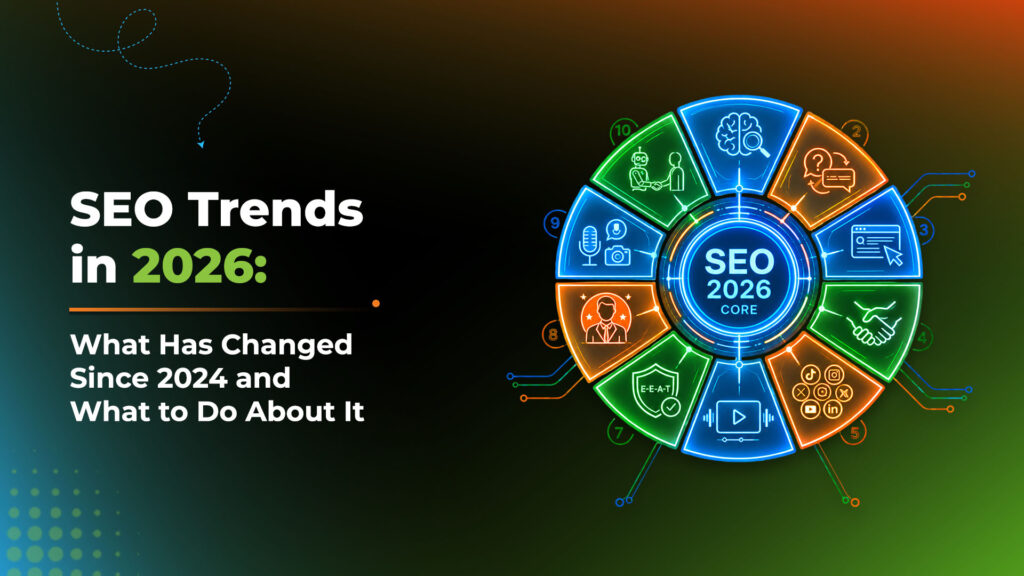
Most SEO trend lists from 2024 predicted a busy year for voice search, long-form content and privacy. Two years on, the biggest shift is something those lists barely covered: AI-generated answers now sit at the top of many search results. The good news is that the fundamentals still decide who gets seen. This guide separates what held up from what changed, so you know where to spend your time in 2026.
What Changed Since the 2024 SEO Trends
Four changes matter most for anyone planning SEO this year.
- AI features are part of Search. AI Overviews and AI Mode pull supporting links from pages that are already indexed and eligible to show a snippet.
- Interaction to Next Paint (INP) replaced First Input Delay (FID) as a Core Web Vital in 2024.
- FAQ rich results are gone. Google stopped showing them in Search from May 7, 2026.
- Voice-specific tactics are no longer a priority. The useful part, answering natural-language questions clearly, now applies to AI search features.
You will see claims that AI search needs a new set of tricks, special files or special markup. Google’s own documentation says there are no additional requirements to appear in AI Overviews or AI Mode, and no special schema.org markup is needed. Treat paid “AI visibility” packages with caution.
SEO for AI Search: AI Overviews and AI Mode
This is the trend that replaces most of the old voice search advice. Searchers increasingly see a generated summary before the regular results, and your page has to earn a place as a supporting link.
What Google Says Eligibility Requires
According to Google Search Central, a page can appear as a supporting link if it is indexed and eligible to be shown in Search with a snippet. That is the same bar as any other result. It also means a page stuck in “Discovered, currently not indexed” has no chance of appearing at all, which makes indexing quality the first job.
How to Make Your Content Easier to Use and Cite
- Answer the main question near the top of the page, then add depth below it.
- Use clear headings that match how people phrase their questions.
- Keep important information in text, not only in images or video.
- Be specific. Named examples, local detail and original data are harder to replace than generic summaries.
- Make sure Googlebot can crawl the page and that internal links point to it.
Traffic from AI Overviews and AI Mode is counted in the Web search type of the Search Console Performance report. Watch engagement and conversions in your analytics as well as clicks, because Google reports that clicks from results with AI Overviews tend to be higher quality. If you want help adapting your content, see our AEO and GEO services.
Search Intent, Semantic SEO and Entities
Search engines now interpret meaning, not just matching words. That makes semantic SEO less of a trend and more of a baseline: cover a topic fully, use the terms real people use, and be clear about who and what the page is about.
Write for the Question Behind the Query
Before drafting, check what already ranks and what the searcher is trying to do: learn, compare, or buy. A page that mixes all three usually satisfies none of them. One page should serve one main intent.
Be Clear About Entities
Name your business, services, locations and people consistently across your site, your Google Business Profile and your other listings. Consistency helps search engines connect the dots without guessing.
E-E-A-T and Trust
E-E-A-T stands for Experience, Expertise, Authoritativeness and Trustworthiness. Two points are often misunderstood. First, Google states that E-E-A-T is not a single ranking factor. Second, it describes trust as the most important element, with the others contributing to it.
Show Who Wrote It and Why It Can Be Trusted
Google’s guidance uses a simple “Who, How and Why” check. Show real authorship with accurate bylines, explain how the content was produced where readers would reasonably wonder, and make sure the main purpose is to help people.
Using AI to mass-produce pages to influence rankings falls under Google’s spam policy on scaled content abuse. AI can speed up research and drafting, but every published page still needs a human who checks the facts and adds real experience.
Video SEO
Video still earns attention in search, but the technical basics matter more than tag lists. Google needs to find a page that actually hosts the video and understand what it shows.
Practical Video Optimisation Steps
- Put each video on an indexable page that is not blocked by robots.txt, noindex or a login.
- Add
VideoObjectmarkup with the requiredname,thumbnailUrlanduploadDate, plus a description and duration. - Add a transcript on the page so the content is accessible and readable as text.
- Use
Clipmarkup or timestamps in a YouTube description if you want key moments to appear.
These steps follow Google’s video structured data documentation. Crawling and indexing can still take several days after you publish.
Mobile-First Indexing and Core Web Vitals
Mobile-first indexing is no longer a trend to prepare for. Google uses the mobile version of your content for indexing and ranking, so the mobile page is the page that counts.
Keep Mobile and Desktop Content Equal
Google’s mobile-first guidance asks for the same primary content, structured data, titles, meta descriptions, headings and image alt text on both versions. Content that exists only on desktop may not be used for indexing.
Know the Three Core Web Vitals
A page passes only when it meets all three targets at the 75th percentile of real visits, measured separately for mobile and desktop.
| Metric | What it measures | Good score |
|---|---|---|
| Largest Contentful Paint (LCP) | Loading speed of the main content | 2.5 seconds or less |
| Interaction to Next Paint (INP) | How quickly the page responds to taps and clicks | 200 milliseconds or less |
| Cumulative Layout Shift (CLS) | Unexpected movement while the page loads | 0.1 or less |
Core Web Vitals are one part of page experience, not a shortcut to rankings. Fix them when real-user data in Search Console shows a problem, and do not sacrifice useful content to chase a perfect score.
Local SEO for Canadian Businesses
Local SEO matters more when searchers want a provider nearby. The core work is unglamorous and still effective.
Keep Your Local Signals Accurate
- Keep your Google Business Profile current, including categories, services, hours and contact details.
- Use the same business name, address and phone number everywhere it appears.
- Ask real customers for reviews and reply to them professionally.
- Build location pages only for places you genuinely serve, with content that is useful for that area and not a copy with the city name swapped.
If you serve multiple cities, our local SEO services cover profile management and location content.
Structured Data and Schema Markup
Structured data helps search engines understand a page, and it still earns rich results for many content types. What has changed is which ones.
What to Keep, Add or Stop Expecting
- Keep and add markup that matches the visible page, such as Organization, LocalBusiness, Article, Product and VideoObject where relevant.
- Stop expecting FAQ rich results. Google’s documentation says the feature no longer appears in Search starting May 7, 2026. Do not add FAQ markup to chase a search appearance.
- Do not expect schema to unlock AI features. Google says no special structured data is required, only that any markup you use matches the text people can see.
You can read the change on the FAQ structured data page.
Content Quality Over Content Length
The 2024 advice to create long-form, comprehensive content needs a correction. Length alone has never been a ranking goal. Google’s guidance points to content made for people: does it show first-hand experience, does it add something beyond what is already out there, and would a reader feel they learned enough?
A Simple Quality Check Before You Publish
- Does the page answer one clear question or need?
- Is there at least one original element, such as an example, data point, screenshot or local detail?
- Can you name who wrote it and why they are qualified?
- Would you be comfortable if a customer read it side by side with a competitor’s page?
Privacy, Security and Trust
The 2024 trend promised a ranking boost from data protection. Treat privacy as a trust and compliance issue rather than a ranking tactic. Canadian businesses collecting personal information are subject to privacy law such as PIPEDA, plus provincial rules in some regions, so a clear privacy policy, secure forms and honest consent practices protect both your visitors and your reputation.
Where to Start: A Practical Priority List
| Priority | Action |
|---|---|
| 1 | Make sure important pages are crawlable, indexed and eligible to show a snippet. |
| 2 | Rewrite thin or outdated pages to answer one clear intent with original detail. |
| 3 | Fix real Core Web Vitals problems found in Search Console. |
| 4 | Update your Google Business Profile and local details. |
| 5 | Add accurate structured data and remove outdated expectations such as FAQ rich results. |
| 6 | Add video, with a transcript, where it helps explain your service. |
Frequently Asked Questions
Are the 2024 SEO trends still relevant?
Mostly, but some have changed. Mobile-first indexing, user experience, local SEO and trust still matter. FAQ rich results are gone, FID has been replaced by INP, and AI search features now shape how results look.
Do I need special optimisation for AI Overviews and AI Mode?
No. Google states that there are no additional requirements or special optimisations needed. Pages need to be indexed and eligible for a snippet, and the usual fundamentals such as crawlability, internal links and helpful content apply.
Is E-E-A-T a ranking factor?
Not as a single factor. Google uses a mix of signals that identify content with strong E-E-A-T, and it describes trust as the most important element.
Should I remove my FAQ schema?
You do not need to rush. FAQ rich results no longer appear in Google Search, so the markup will not earn that appearance. If the questions and answers are useful to readers, keep them on the page as visible content.
Which metric replaced First Input Delay?
Interaction to Next Paint (INP) became a stable Core Web Vital in 2024 and replaced FID. A good INP is 200 milliseconds or less.
Is longer content better for SEO?
Not by itself. A page should be as long as it needs to be to answer the question well. Original detail and clear structure matter more than word count.
Final Thoughts on SEO Trends in 2026
The SEO trends for 2026 reward the same things that worked before: pages that are indexed, fast on mobile, trustworthy and genuinely useful. The change is that AI summaries make weak, generic pages easier to skip. Start with indexing and content quality, then layer on local, video and structured data work where they fit your business. If you want a second opinion on where to begin, our SEO team can review your site.