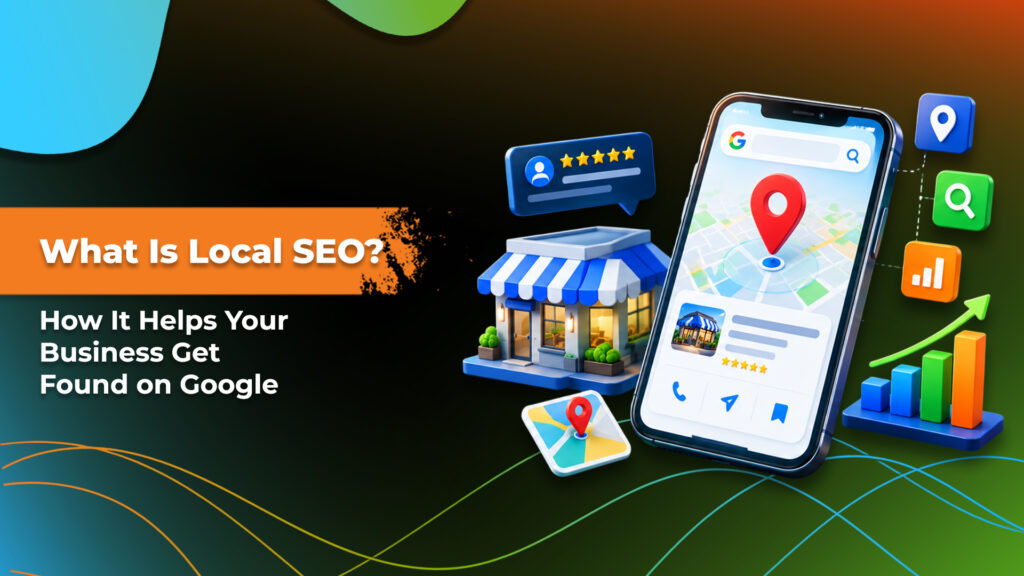
What is local SEO? It is the work of helping your business appear when people search for services near them, in the Google local pack, Google Maps and regular organic results. It combines a well-kept Google Business Profile, consistent business details, customer reviews and location-focused pages, so Google can see you are a relevant, nearby and trusted choice.
Local SEO helps a business show up when someone searches for what it offers in or near a place. Google names three local ranking factors: relevance, distance and prominence.
What Is Local SEO and How Does It Work?
Local search engine optimization works because Google treats some searches as local, even when no city is typed. A search like “plumber near me” has clear location-based search intent, so Google shows nearby businesses. Tap each tab to see where you can appear.
Where can your business appear?
When Google decides a search has local intent, such as “dentist near me”, it can show a map with a few businesses above the regular results. This is the local pack.
What drives it: your Google Business Profile, reviews and how close you are to the searcher.
People also search inside Google Maps, where businesses appear as pins and listings. They can call, get directions or visit your website straight from the listing.
What drives it: the same Business Profile data, so one well-kept profile supports both the pack and Maps.
Your website can also rank in standard results for searches such as “pool repair Ottawa”. These organic local search results come from your pages, not your profile.
What drives it: useful service and location pages, links, and a technically healthy site.
| Where | What Google reads | Your main lever |
|---|---|---|
| Local pack | Business Profile, reviews, distance | Profile accuracy and reviews |
| Google Maps | Business Profile, distance, prominence | Complete profile, photos, hours |
| Organic results | Website content, links, site health | Local landing pages and content |
What Are the Local Search Ranking Factors?
Google’s own guide to improving your local ranking explains that local results rely mainly on relevance, distance and prominence. Open each one below.
1. Relevance
How well your Business Profile matches what someone searched for. Complete, accurate information helps Google understand what you offer.
Do thisPick the most accurate primary category, list your services and write a clear description.
Watch forDo not add keywords to your business name. It must match your real-world name.
2. Distance
How far your business is from the person searching. If they do not share a location, Google uses what it already knows about where they are.
Do thisKeep your address and service area accurate. You cannot change where customers stand, so focus on what you control.
Watch forFake or shared addresses can lead to a suspended profile.
3. Prominence
How well known your business is. Google says this draws on information from across the web, including links and reviews.
Do thisAsk happy customers for reviews and reply to each one. Earn mentions from local sites.
Watch forNever buy reviews. It breaks Google’s policy.
You cannot pay Google to rank higher in local results, so the work is about accuracy and reputation.
What Does Local SEO Look Like for a Real Business?
Here is an illustrative example, not a client result. A family-run pool company in Ottawa wants more repair calls. This is the path a customer takes, and what the business did to be there.
| Step | What the searcher sees | What the business did |
|---|---|---|
| 1. Search | Someone in Ottawa types “pool repair Ottawa” | Built a service page that matches this need |
| 2. Local pack | A map and a short list of nearby pool companies | Kept its Business Profile complete and accurate |
| 3. Trust check | Star ratings, recent reviews, photos | Asked for reviews after every job |
| 4. Click | They open the website or tap call | Used one clear phone number everywhere |
| 5. Decision | They read the service page and book | Wrote clear pages for each service and area |
For a real campaign, read the Ottawa Valley Pools case study. Over that project the site recorded 1,199% more new users and 51.64% more non-branded traffic. Results differ for every business.
What Are the Main Parts of Local SEO?
Open each of the six areas below.
Google Business Profile optimization
Your profile is the main driver of the local pack and Maps. Fill in every field honestly.
Do thisAdd categories, hours, services, photos and a short description.
Local keyword research and location-based search intent
People add a place or “near me” because they want something close by. Local keyword research finds those phrases.
Do thisMatch each page to one need, such as a service plus a city.
Watch forDo not repeat the city in every sentence.
NAP consistency and local business citations
NAP means name, address and phone number. A citation is a mention of them on another site, such as a directory.
Do thisUse the same details everywhere, down to the suite number.
Watch forOld listings with a previous address confuse customers and search engines.
Customer reviews and ratings
Reviews show trust and feed prominence. Recent, specific reviews help people choose.
Do thisSend a direct review link after each job and reply to every review.
Local landing pages
One page per main service or area gives Google and visitors a clear answer. This is how you rank in organic results.
Do thisWrite each page for real local customers, with unique content.
Watch forCopying one page and swapping the city name looks thin.
Website signals and structured data
Your site should load fast, work on phones and state your business details clearly. Google documents LocalBusiness structured data for sharing hours, departments and reviews.
Do thisAdd LocalBusiness markup that matches what is visible on the page.
What Are the Benefits of Local SEO for Businesses?
The benefits of local SEO for businesses come from reaching people who are already looking.
| Benefit | Why it happens |
|---|---|
| Reach nearby buyers | You show up when people search for what you sell in your area |
| More trust | Ratings, reviews and photos appear before a visit |
| Easy contact | Calls, directions and website clicks are one tap away |
| Measurable results | Business Profile reports calls, direction requests and website clicks |
| Fair competition | A smaller business can compete in its own neighbourhood |
Where Should You Start?
You can do much of this yourself. Tick what you have already done to see how far along you are.
Your local SEO starter checklist
Do You Need Local SEO Services?
Local SEO services help when you manage several locations, face strong competition or lack time for reviews, listings and content. Digitalise includes local SEO in its SEO service. Accelerate SEO (C$999) covers local SEO, and Scale SEO (C$1,199) adds multi-location SEO, as listed on our pricing page. Prices are in Canadian dollars, and billing terms are confirmed on a free consultation. We do not promise rankings, because no one can.
Frequently Asked Questions
What is local SEO in simple terms?
Local SEO is the work of helping your business appear when people search for services in or near a place. It covers your Google Business Profile, reviews, listings and location-focused website pages.
How is local SEO different from regular SEO?
Regular SEO focuses on ranking web pages. Local SEO adds the local pack and Google Maps, which rely on your Business Profile, reviews and distance, alongside your website.
Do I need a physical address for local SEO?
Not always. Google lets service-area businesses hide their address and list the areas they serve. Whatever you choose, it must follow Google’s guidelines.
How long does local SEO take to work?
Google does not publish a timeline, and no one can guarantee a ranking. Competition, profile quality and review volume all affect how quickly you see movement.
How much do local SEO services cost?
It varies by scope and market. Digitalise lists Accelerate SEO, which includes local SEO, at C$999 on its pricing page, in Canadian dollars.
Final Thoughts
Local SEO comes down to being accurate, visible and trusted in the places your customers look. Start with your Google Business Profile, then fix your listings, ask for reviews and build clear pages for each service and area.